Customer Profile First: Why The Journey To PMF Begins With Learning Who the Customer Really Is
Date August 26, 2026
Author Gorilla Capital
This article is the fourth part of The Founder Journey, our 12-part series, and the fourth chapter of Build to Learn.
Build to Learn — Chapter 4
Where Early Understanding Actually Begins
In early-stage startups, there is often an assumption that the Ideal Customer Profile can be clearly defined from the start. In practice, it rarely works like that.
At the beginning of the journey, the company does not yet know enough to define its ideal customer with precision. It may have a strong hypothesis. It may have a clear view of the problem it wants to solve. But the connection between the problem, the customer, and the willingness to act is still forming.
Customers do not make decisions based on how a product is described. They act based on their own reality, their constraints, and how strongly a problem affects them right now. If the problem is not meaningful enough, if it sits in the category of “interesting” rather than “important now,” then even a strong product will struggle to gain traction.
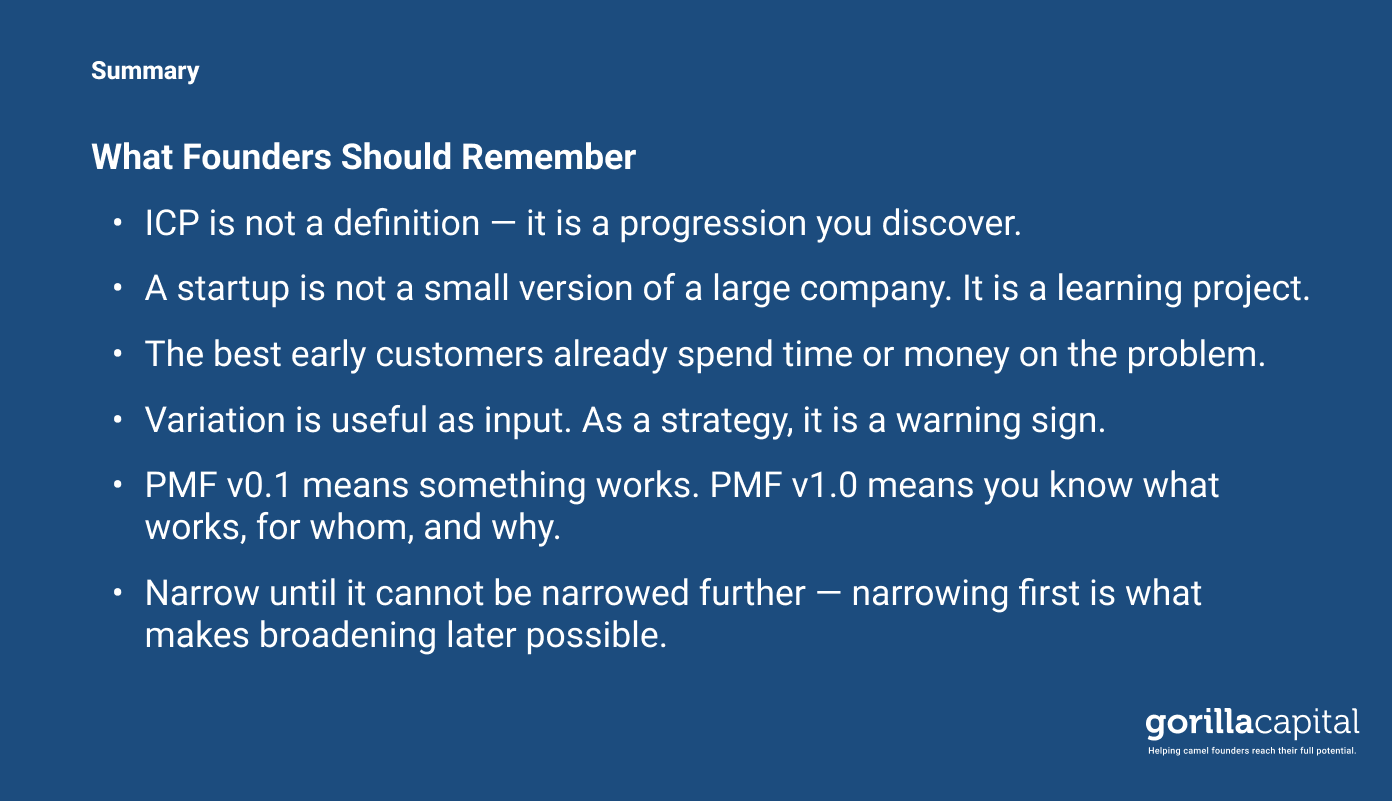
The first customers worth finding are the ones with an urgent reason to buy — a problem so pressing they want it solved now, not someday. You’ll recognize them by one thing: they’re already spending time or money trying to solve it. This is why product-market fit does not begin with the product. It begins with the customer and the problem. And more specifically, it begins with understanding which customer actually cares enough to act.
That may sound straightforward, but it has deep consequences for how an early-stage company should operate. If the company does not yet know, with enough clarity, who has the strongest pain, who feels urgency, who can make the decision, and who gets lasting value, then the primary job is not optimization. It is learning.
Why Learning Comes Before Precision
This is where early-stage company building often becomes misunderstood.
Much of the language around startups comes from later-stage companies. Execution. Growth. Scale. Hiring. Market share. Efficiency. These concepts are valid, but they assume something important: that the company already understands its customer, its problem, and its business.
At the beginning, that is not yet true.
A startup is not a small version of a large company. It is a system operating under uncertainty. It does not yet know who its real customer is, what problem matters most, why one customer buys and another does not, or what part of the product creates real value.
That is why a startup is not primarily an execution project. It is a learning project. Learning here is not abstract. It is not about gathering general information. It is about reducing uncertainty around the customer. Why do they buy? Why do they not? What makes them act now instead of later? What makes the problem urgent enough to prioritize? This is the kind of learning that moves a company forward.
If that learning is not happening, activity can be misleading. There may be product development, customer conversations, pilots, even some revenue. But if the company is not becoming clearer about why customers buy and for whom the value is strongest, then it is not progressing in a meaningful way. It is moving, but not necessarily moving closer to product-market fit.
The Role of Early Customers
This is also why early customers need to be understood differently.
At the beginning, there is no true ideal customer profile yet. There are only customers who are willing to take a risk. They are not buying because everything is complete or proven. They are buying because the problem is painful enough and they are open to trying something new. From the outside, these customers often look inconsistent. Different industries, different use cases, different expectations. From a
scaling perspective, they are not yet a clear segment.
But that is not their role.
Their role is to enable learning and survival.
Early customers provide revenue, which helps the company stay alive. But more importantly, they provide insight. They show what makes someone commit in practice. They reveal which problems are strong enough to trigger action. They surface objections, hesitations, and priorities. They show whether value is immediate or fragile. And they show something even more important: whether the company is
being pulled by real demand, or whether the founder is still pushing each deal forward manually.
This is also why large enterprise customers are often a difficult first ICP. Big organizations rarely risk their operations or their brand on a small startup. They want a proven, reliable vendor, and that is exactly what an early-stage company cannot yet claim to be. The willingness to take a risk that early customers show is something large buyers can rarely offer.
This is why variation at this stage is not necessarily a weakness. Variation here means that the product gets used by different kinds of customers, for different problems, in different ways. Which use cases exist cannot be known in advance. They have to be found.
So the work happens in steps. First, look for different use cases on purpose. Then, for each one, learn whether the problem is real and who actually has it. Then drill deeper: which customers have the most painful, “hair on fire” version of the problem — the ones who need a solution now, not someday? That is the best customer.
This is also how exploring and drifting can be told apart. If meeting different types of customers makes it clearer where the pain is strongest, the company is exploring. If nothing becomes clearer, it is drifting. “This can be used for anything” is a dangerous signal, not a strength. Variation is useful as input. As a strategy, it is a warning sign.
The validation phase (or ‘PMF v0.1’)
This phase often creates a misleading sense of progress.
It is common to see early traction across multiple customer types. There may be deals in different segments. Different use cases seem to work. The solution appears broadly applicable. This can look like product-market fit.
In reality, this is often what can be described as validation or ‘PMF v0.1’: a stage where something works, but it is not yet clear what works best, for whom, and why. This is an important milestone, because it means the company is not building in the wrong direction. But it is not yet a stable foundation for scaling, because the underlying logic is still unclear.
The temptation at this stage is to expand. More customers. More segments. More features. More markets. The assumption is that growth will come from doing more.
In practice, the opposite is required.
The next step is narrowing, not serving more customers, but understanding which
customers matter most.
The first real sign of validation is therefore not just that customers are buying. It is that a clearer pattern begins to emerge. Certain customers move faster. They understand the problem immediately. They require less convincing. They get value more quickly. The same use cases appear repeatedly. The same language resonates across conversations.
Part of this pattern is not only who the customer is, but the use case. The early job is to find a use case where the product is good enough as it is today, without promises about the roadmap. In other words, the ideal customer is not just a segment. It is a segment plus a use case where the current product already delivers.
At the same time, other segments start to fall away. Some require heavy explanation. Some never quite convert. Some churn quickly. Some do not prioritize the problem enough to act. This contrast is where clarity begins. The company starts to see that not all customers are equal, and more importantly, it starts to recognize which customers it should focus on.
This is where the Ideal Customer Profile begins to take shape, not as a definition on a slide, but as a pattern observed in reality.
ICP Is Not a Definition. It Is a Progression.
This is why ICP should not be treated as something fixed.
It is something that evolves.
At the beginning, the company is exploring. It is testing different customer types, different use cases, different ways of describing value. Some combinations work better than others. Some create stronger pull. Some create more friction. Over time, patterns begin to emerge.
Those patterns are the foundation of ICP. Not assumptions, or preferences, but observed behavior: who buys, why they buy, and why they stay.
The move toward ICP v0.1 happens when the company starts narrowing based on this evidence. The question shifts from “who could we sell to?” to “where do we consistently create value and close deals?” This narrowing is one of the most difficult steps in the early journey because it feels like saying no. Fewer customers. Fewer opportunities. A smaller initial market. In practice, focus means saying no, and often a hard no, to customers and segments that would be perfectly decent business but are not the right ICP. This is counterintuitive for many founders. The instinct says the product could work here, and there, and over there too. But the aim has to be set precisely before anything starts to fall.
A useful rule of thumb: narrow the ICP until it cannot be narrowed any further. The niche should be small enough that a leading position in it is actually achievable. This is often where speed increases. By focusing on a smaller segment, the company can go deeper. The product aligns more closely with the use case. Messaging becomes clearer. Sales becomes more repeatable. And something else begins to build as well: references.
Each customer is no longer just revenue. It is proof. Proof that the problem is real, that the solution works, and that the company can be trusted. As these references concentrate within a specific segment, they begin to create momentum. Selling becomes easier, not because the sales process improved, but because the company is now operating within a space where it genuinely fits.
From Learning to PMF v1.0
Reaching PMF v1.0 is not about serving more customers. It is about serving the right customers with consistency.
At this stage, the customer profile is no longer a hypothesis. It is grounded in real patterns. The company knows who the customer is, what problem matters, how to reach them, and how value is delivered in a repeatable way. Sales becomes less about convincing and more about matching. Marketing becomes clearer because the message is based on real insight rather than assumption. References compound
because they are concentrated within a segment that fits.
This is also the point where scaling begins to make sense. Hiring salespeople, investing in marketing, building processes, and expanding go-to-market efforts all become more rational once the underlying fit is clearer. Before this stage, these actions tend to amplify confusion. Until the company knows where the bullseye is, the best and narrowest ICP, it cannot scale sensibly. The machine does not hold. It
breaks. After this stage, they start to amplify something real.
This is the key difference between PMF v0.1 and PMF v1.0. In PMF v0.1, something works, but the logic is still forming. In PMF v1.0, the company has learned enough to make that logic repeatable. That is what gives the company the right to scale.
One more thing is worth saying about narrowing: the early ICP is not final or forever. Once the company has built a leading position in its niche, and the niche has to be narrow enough for that to be possible, it can begin expanding into adjacent use case groups. The logic sounds like this: this group could use it too, but the product needs to be adapted in specific ways before it fits there. Each expansion is a new, smaller search for fit, done from a position of strength rather than from scratch. Narrowing first is what makes broadening later possible.
Why Learning Has to Stay First
All of this comes back to one central point.
At the beginning, learning is not one priority among many. It is the priority.
The risk in early-stage startups is not only that they move too slowly. It is that they move in the wrong direction with too much confidence. Hiring before understanding. Expanding before narrowing. Scaling before learning. These actions are not wrong in themselves. They become risky when they are done before the underlying business is clear, because at that point the company is no longer learning efficiently. It is amplifying its own assumptions.
The goal at this stage is not to look like a finished company. It is to become less wrong. To move from multiple possible directions to one clearer path. To understand why customers buy, why others do not, and where the company creates real value. Because until that is clear, the company still does not know what deserves to be scaled.
That is why early ICP is not something you define once. It is something you discover. And that is why the first meaningful sign of PMF v0.1 is not just that someone bought. It is that the company begins to see, with growing consistency, who buys more naturally, why they buy, and where it is starting to build a real position.
Understanding who you serve and why they buy is therefore not a step in the process. It is the process.