This article is the second part of The Founder Journey, our 12-part series, and the second chapter of Build to Learn.
Build to Learn — Chapter 2
Funding Is Fuel — Not a Destination
There is a number that follows many founders around. The amount they raised. The valuation they achieved. The round size they announced. It appears in bios, articles, conversations, and pitch decks. The market treats it like a measure of quality. Founders start to treat it that way too.
But that number is not the business.
Funding is not success. It is fuel — a tool that is useful, necessary at times, and often important. But still only a tool. It helps a company move to the next stage, learn faster, and reduce uncertainty. What it cannot do is replace the work of building something a real customer actually wants to pay for. The founders who understand that early build differently, and they tend to build better. They raise what they need, not what they can get. They stay close to the customer. They move toward the point where the business sustains itself. And when they raise the bar, they do it from a position no story-first company can match: evidence.
This distinction sounds obvious. But startup culture constantly pushes against it. Raising a big round is celebrated as a signal of success. Valuation is discussed as if it were fact. Founders are encouraged to raise as much as possible, as early as possible, as if capital were the raw material of progress.
It is not. Understanding is the raw material. Capital only helps if it is used to find that understanding — one leg at a time.
The Wrong Question
Most early-stage fundraising conversations start from the wrong place. Most founders walk into a raise asking the wrong questions. How much can we get? What valuation can we defend? How long will the runway last?
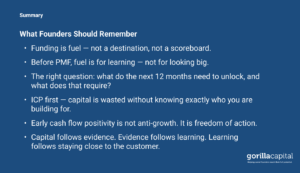
These are the wrong questions. The right question is simpler and harder: what do the next 12 months need to unlock, and what does that require?
That reframe matters. It shifts the logic from maximizing capital to targeting it. It makes the raise serve the company rather than the other way around. And it changes how founders think about milestones, not as boxes to tick for the next round, but as genuine proof points that reduce the most important uncertainties right now.
Before product-market fit, a startup is not a growth machine. It is a learning system operating under uncertainty. The goal is not to spend ahead of evidence. The goal is to find the truth as fast as possible, while staying alive. Funding is fuel for that learning. Big decisions made early, based on assumptions rather than evidence, are hard to undo. Raise when you know enough, and only as much as the next leg requires.
What the Next 12 Months Need to Unlock
Every funding round should be built around a concrete answer to one question: what needs to be true at the end of this 12-month leg?
Not a vague aspiration. Not a fundraising story. A specific set of things that, if proven, would meaningfully reduce the company’s biggest uncertainties.
That might mean:
- Proving that a specific customer has a real, recurring problem urgent enough that they would pay to have it solved
- Finding the first 3–5 customers who match a clear ICP and come back without being pushed
- Showing that early revenue is not founder hustle but the beginning of a repeatable pattern
- Testing whether the product solves the job well enough that customers would be disappointed to lose it
- Proving that onboarding works without heavy founder involvement
Each of these is a legitimate unlock. Each one earns the right to the next stage. And each one should drive the capital ask, not the other way around.
The common mistake is to raise based on a story and then figure out what to do with the money afterward. That reverses the order. Milestones should define the raise. The raise should fund the milestones. And the milestones should answer the questions that matter most right now.
Too much capital — and this is the part startup culture rarely says clearly — is more dangerous than too little. When money is abundant, urgency around prioritization disappears. Founders start hiring before the model is understood, buying customers before retention is proven, and building infrastructure before anyone has validated the demand. Costs should be a response to what customers are already telling you. When capital lets you skip that signal, the business grows busy without growing real. That is one of the simplest and most common ways early-stage companies die.
The right raise is not the maximum. It is the amount needed to complete the next learning leg properly, with enough room to make small mistakes and still keep moving.
ICP Before Capital
There is one thing that must come before almost any meaningful use of funding: knowing exactly who you are building for.
The Ideal Customer Profile is not a marketing exercise. It is the foundation of the entire business. Without it, capital gets spread across segments. Product decisions serve too many masters. Sales motions produce inconsistent results. Early traction looks promising, but does not repeat. The company grows busy without growing clear.
At Gorilla Capital, we see this consistently. Knowing exactly who you are building for is not where you start; it is what you earn through early exploration. Founders have to search broadly first, mapping different use cases, testing assumptions, and finding the one customer group where the problem is most urgent. Only once that answer is clear does it make sense to bring in capital. The startups that use funding most efficiently are the ones that have done that search before they raised. They know which customer has the most urgent version of the problem. They know what changes for that customer when the problem is solved. And because they have gone narrow enough, they can build exactly the right solution for that audience.
That knowledge is what makes capital work.
Without it, more money only amplifies confusion. With it, even a modest raise can drive significant progress, because the company knows exactly where to direct the fuel.
AI tools and vibe coding have made building faster and cheaper. That is genuinely useful. It lowers the cost of testing and reduces the amount of capital needed to reach the next milestone. But it does not change the underlying discipline. Cheaper building still needs to be pointed at the right customer. The question of who you are building for, and why they actually buy, cannot be coded away. Customers rarely articulate their real reasons. Understanding those reasons requires proximity, observation, and time.
Why Early Cash Flow Positivity Matters
Profitability is where the conversation often gets uncomfortable.
Startup culture treats cash flow positivity as the enemy of growth. If your business can sustain itself early, the logic goes, you are thinking too small. You should be reinvesting everything into speed. You should be burning to blitz-scale.
That logic can be valid. But only after the engine is real. Before product-market fit, it is not a growth philosophy. It is a way of spending ahead of truth.
Aiming early for cash flow positivity is not about rejecting ambition. It is about building freedom of action.
“The first month when you are cash flow positive based on real revenues — that’s a real achievement. That’s something sustainable. A funding round is actually just living off with someone else’s money.”
— Risto Rautakorpi, GorillaCast Ep. 1
When customer revenue starts carrying more of the business, the company gains something that external capital can never fully provide: control over timing. It can choose whether to raise. It can wait for evidence to improve before taking the next step. It can negotiate from strength instead of desperation. It can survive a difficult funding environment without dying from it.
Funding environments change. Capital that was easy to raise in one year becomes hard to find in the next. Investor appetite shifts and valuations compress. A startup that has built toward self-sustainability is resilient to all of that. One that depends on outside capital to cover basic operations is permanently exposed.
The goal is not to chase cash flow positivity as a number on a page. The goal is to build a company where the business can sustain itself on customer revenue, where that revenue increasingly takes over the job that investor capital started. That transition changes the company’s position entirely. Growth becomes more disciplined. Product decisions become more grounded. The path to exit becomes cleaner. Acquirers value businesses that can stand on their own.
Build for the Exit, Not the Round
There is a trap built into the way most startups think about fundraising. Each round becomes its own goal. Founders optimise for the size of the next raise, the valuation they can defend, the story that will land best with investors. The numbers grow. The headlines improve. But none of it is real until one moment: the exit.
The exit is the only point at which a founder and an early investor actually receive money. Everything before that is paper. A high valuation in round three does not pay anyone. A clean, well-timed exit does.
This matters because optimising for intermediate rounds and optimising for exit outcomes are not the same thing. Often they pull in opposite directions. A company that raises large rounds at high valuations early boxes itself in. Only a very large outcome can justify the structure. Anything below that threshold — even what would otherwise be a meaningful, successful exit — starts to look like failure. The goalposts have been moved so far that most companies cannot reach them.
The traditional venture capital model runs on this logic. Only big is beautiful. Swing for the unicorn or do not swing at all. And if you accept that framing from the start, you have already made a bet that only the rarest of outcomes can validate.
Gorilla starts from a different place. In the Nordics, the median tech exit lands around €15 million. That is not a consolation prize. That is the most likely outcome for a well-run, focused company solving a real problem for a specific customer. And every company that has eventually become large was first worth €10–15 million. That number is not a ceiling. It is a checkpoint.
The camel does not become a unicorn by pretending to be one from day one. It becomes one by making the journey well, step by step, with controlled risk, staying alive long enough to earn the right to go further.
So the goal is not to raise the most. The goal is to build a business healthy enough that you get to choose: exit at €15M, grow further on customer cash flow, or accelerate with another raise from a position of strength. That optionality is worth more than any valuation achieved too early.
The Gorilla Way
At Gorilla Capital, we do not fund stories. We fund the next leg of the journey.
That means we invest in founders who can answer the right question: what needs to be true in the next 12 months, and what is the minimum capital needed to get there?
It means we keep valuations grounded in what has actually been proven — not in what might one day be true. And it means we stay close to founders throughout the learning journey, because the work of finding product-market fit, sharpening the ICP, and moving toward early cash generation is not a solo act.
Capital efficiency is not a constraint we impose. It is a capability we build together. Founders who stay disciplined early keep ownership. They keep options open. And when they have found the real engine, they raise from a position of genuine strength — with evidence behind them, not just a story.
Signs that the fuel is being used well:
- You can describe your next milestone in one sentence
- Every euro spent is tied to a specific learning goal or proof point
- You know your ICP precisely enough to say who is not your customer
- You are moving toward customers funding more of your operations
- You measure progress by evidence, not runway
Final Reflection
Funding is not success. It is an input.
The startups that last are not the ones that raised the most. They are the ones that used what they raised to find something true — a real customer, a real problem, a real reason to buy. They stayed close to the ground. They kept burn low enough to be wrong and survive it. They moved toward the point where customers, not investors, were carrying the business forward.
That is a different kind of company. Quieter on the outside. Stronger underneath.
And when the time comes to raise the bar, they raise it from a position no story-first company can match: evidence.
Next in The Founder Journey:
Problem Level — Finding the Pain Worth Solving